Halloween Sale
50% off Premium Yearly
- Page 1/4
'%20fill='%23000000'%3e%3cg%20id='Rating-Card'%20transform='translate(120.000000,%20487.000000)'%3e%3cpath%20d='M848.295367,82.286474%20C848.68919,81.9045087%20849.327703,81.9045087%20849.721525,82.286474%20L854,86.4361302%20L858.278475,82.286474%20C858.672297,81.9045087%20859.31081,81.9045087%20859.704633,82.286474%20C860.098456,82.6684393%20860.098456,83.2877274%20859.704633,83.6696927%20L854.35654,88.856763%20C854.159628,89.0477457%20853.840372,89.0477457%20853.64346,88.856763%20L848.295367,83.6696927%20C847.901544,83.2877274%20847.901544,82.6684393%20848.295367,82.286474%20Z'%20id='Path'%3e%3c/path%3e%3c/g%3e%3c/g%3e%3c/g%3e%3c/svg%3e)
The thing to focus on is something Chairman Powell said last week in his press conference when asked about the state of the labour market in the US. He said while the US economy has been generating an average of 40k jobs in the last 6 months, the FOMC believes that this number is being overstated by up to 60k jobs a month. That would imply that for the last 6 months, on average, the US economy has been losing 20k jobs per month.
Some market participants are looking at that and saying that the Fed needs to be more aggressive in cutting rates. Yet others say, wow, if we're starting to lose jobs that means weak economic performance and it isn't good for equity multiples.
For him, that's the debate going forward. Can we muddle through in a Goldilocks fashion? The US administration wants to run the US economy hotter to keep the stock market more robust in a midterm election year. So 2026 is shaping up to be a very interesting dynamic.

When we look at what's priced into the market, we're essentially looking at one more rate cut, maybe two, between now and the end of next year. Markets are already starting to price in rate hikes based on that.
What that tells him is that they're really worried about inflation. The Fed really has to be very delicate in its assessment and balancing those 2 risks of jobs and inflation in 2026. Larry wishes he had a crystal ball that made it clear, but that's where his focus will be.
It started with the supply-side shock from Covid, which is now largely over. But we're entering a world of less globalization, which means fewer efficiencies, and higher costs.
The question is whether the new dynamic of AI is going to raise productivity enough to completely offset any of the inflationary pressures? History tells us that technology and innovation are very disinflationary. So there's the camp that believes we shouldn't worry about inflation, and the camp that believes we should. That second camp is looking at the massive amount of government debt in the world that's going to get very expensive if inflation comes unanchored.
The unofficial new voting member of the Federal Reserve in 2026 and beyond (aka The White House) does care what the stock market does. He thinks there's going to be some influence. We heard from Kevin Hassett over the weekend in the news media that he would be open to listening to suggestions from The White House, though wouldn't necessarily do what The White House said in terms of monetary policy because it's a multi-member voting system.
There's a new dynamic in the FOMC that we haven't seen for decades.
When you buy an ETF in Canada for a foreign market, whether hedged or not hedged, the cost of hedging is very real. On an ETF for the US, there's still withholding tax and other tax issues that happen in the background. Not a lot of tax efficiency in terms of which way you go.
The question is: Do you want that foreign currency exposure or not? His rule of thumb (probably for the next couple of years) is that if the CAD is 70 cents or lower, you want to make sure that the foreign currency is hedged. Fair value for the Canadian dollar is probably a lot closer to 80 cents (or $1.25 in trading terms). When we're at that point, that's perhaps when you'd seek the USD exposure. He doesn't think we'll get much beyond 74-75 cents anytime in the next 12 months. If we do, then he'll change his view on where we're heading in the short run.
There was a pretty dramatic shift that happened during the recent Canadian employment report recently. If we see another strong report, that could push the CAD to being quite a bit stronger.
Global X has a suite of ETFs that are executed by way of a total return swap. Those are the most tax-efficient. There is a slight extra cost to them, but on an after-tax basis it's your best bet for exposure to foreign markets.
The real benefit to a Canadian is the Canadian dividend tax credit -- those only come from Canadian corporations. So if you're buying exposure to a foreign security, even though it trades in Toronto (for example, S&P 500 or MSCI EAFE), those dividends are not treated tax-efficiently but are treated as income.
For income seekers, he's recommended ZWU with its covered call exposure. You get a big percentage of that return coming by way of capital gain, which is your most efficient way of paying tax.
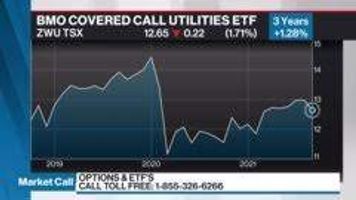
For income seekers, he's recommended this one with its covered call exposure. You get a big percentage of that return coming by way of capital gain, which is your most efficient way of paying tax. The chart shows only the price, and not the total return (which is ~7% annually, and very tax-efficient).

Thinks we'll see this stock behave similarly to BCE stock in recent years. (Though BCE does have a few other issues than Telus has.) Pressure will continue.
That's why he's been recommending ZWU for dividend seekers, as it gives you a better yield at the end of the day and more diversification.

These are Canadian bonds (ZTL is US bonds). Long bond yields in Canada have likely already come as close to the lowest we're likely going to see and, therefore, a bad investment. He'd much rather own a ZTL and wait for a harder economic landing in the US, when we'll see long bonds rally.
Big difference at the long end of the curve between Canada and the US in the last year and a half.


All have very different exposures, so it's hard to compare them.
VEA includes South Korea, EFA does not. ACWX has Canada in it. VEA is likely the most efficient one for foreign exposure. Don't focus on the MER. Instead, focus on the right exposure for your investment goals. Let the MER be the tiebreaker, all else being equal.

All have very different exposures, so it's hard to compare them.
VEA includes South Korea, EFA does not. ACWX has Canada in it. VEA is likely the most efficient one for foreign exposure. Don't focus on the MER. Instead, focus on the right exposure for your investment goals. Let the MER be the tiebreaker, all else being equal.

All have very different exposures, so it's hard to compare them.
VEA includes South Korea, EFA does not. ACWX has Canada in it. VEA is likely the most efficient one for foreign exposure. Don't focus on the MER. Instead, focus on the right exposure for your investment goals. Let the MER be the tiebreaker, all else being equal.

ZUS.U is US exposure. Money market rates and short-term corporate rates in the US haven't come down. The BOC has rapidly cut interest rates, while the Fed is just starting. So you'll get a naturally higher yield in the US.
The difference is if you need that USD yield and income. Yes it's a higher yield, but now you're exposed to the US dollar rather than just a CAD investment. You have to look at your currency exposure too, not just compare the yields.

ZUS.U is US exposure. Money market rates and short-term corporate rates in the US haven't come down. The BOC has rapidly cut interest rates, while the Fed is just starting. So you'll get a naturally higher yield in the US.
The difference is if you need that USD yield and income. Yes it's a higher yield, but now you're exposed to the US dollar rather than just a CAD investment. You have to look at your currency exposure too, not just compare the yields.
%20-%20http://www.bohemiancoding.com/sketch%20--%3e%3ctitle%3ePath%205%3c/title%3e%3cdesc%3eCreated%20with%20Sketch.%3c/desc%3e%3cg%20id='Page-1'%20stroke='none'%20stroke-width='1'%20fill='none'%20fill-rule='evenodd'%20stroke-linecap='round'%20stroke-linejoin='round'%3e%3cg%20id='mobile'%20transform='translate(-353.000000,%20-32.000000)'%20stroke='%2325292B'%20stroke-width='1.5'%3e%3cg%20id='Group'%20transform='translate(321.000000,%2022.000000)'%3e%3cpath%20d='M33,11%20L36.2928932,14.2928932%20C36.6834175,14.6834175%2037.3165825,14.6834175%2037.7071068,14.2928932%20L41,11'%20id='Path-5'%3e%3c/path%3e%3c/g%3e%3c/g%3e%3c/g%3e%3c/svg%3e)
Popular Articles
Most Recent Experts




Most popular stocks on Stockchase
- Toronto-Dominion Bank (TD.TO)
- Enbridge (ENB.TO)
- BCE Inc. (BCE.TO)
- Manulife Financial (MFC.TO)
- Bank of Nova Scotia (BNS.TO)
- Apple Inc (AAPL)
- Suncor Energy Inc (SU.TO)
- Microsoft Corp (MSFT)
- Canadian Natural Rsrcs (CNQ.TO)
- Royal Bank (RY.TO)
- Telus Corp (T.TO)
- TC Energy (TRP.TO)
- Alphabet Inc (GOOG)
- Canadian National R.R. (CNR.TO)
- Crescent Point Energy Corp (CPG.TO)
- Amazon.com, Inc. (AMZN)
- Teck Resources Ltd. (B) (TECK.B.TO)
- BlackBerry (BB.TO)
- Fortis Inc. (FTS.TO)
- NVIDIA Corporation (NVDA)
- Canadian Imperial Bank of Commerce (CM.TO)
- Bank of Montreal (BMO.TO)
- Bank of America (BAC)
- Bombardier Inc (B) (BBD.B.TO)
- Algonquin Power & Utilities Corp (AQN.TO)
- Pembina Pipeline Corp (PPL.TO)
- Meta Platforms Inc (META)
- Walt Disney Co. (DIS)
- Sun Life Financial Inc (SLF.TO)
- Arc Resources Ltd (ARX.TO)