Halloween Sale
50% off Premium Yearly
TSE:ZWU
BMO Covered Call Utilities ETF (ZWU.TO)
16 expert ratings on BMO Covered Call Utilities ETF (ZWU.TO) in the last 12 months: 15 Buy, 0 Hold, 1 Sell. Latest rating: BUY by Larry Berman CFA, CMT, CTA on Oct 5, 2026.
 Financials
  Technical Analysis
Includes pipelines and telcos. Bond yields have moved higher recently, which increases competition for investment dollars. MER is 71 bps. Pretty stable. Own if you need the income; if not, just own utilities in general. Yield is ~7.5%, a combination of dividends plus covered call premiums. Utilities don't form a big part of his portfolios.



Good questions. This ETF will hold a bunch of utility stocks. The likelihood of you losing everything is very, very small -- all the companies within the ETF would have to go to zero. This is not going to happen to your major companies like FTS and ENB.
It'll swing along with the markets. Utilities tend to have a bit more sensitivity to interest rates. In Canada rates probably aren't going anywhere, so that's not much of a worry. Gives you a bit of a yield.
He wouldn't put your whole TFSA in this one vehicle. Good income component as part of a larger portfolio. There's lots of power demand going forward. Some of these companies have projects such as data centres in the US, so that's a benefit. Sector has lots of tailwinds.
Over the long run, has delivered 7+%. A basket of underlying stocks has probably been less than that. The covered call makes the difference. Loves it for dividend seekers. Diversified and tax-efficient.
BMO is coming out with targeted, higher-yield ETFs, but you give up growth and capital gain. You often see the NAV eroded.

Loves these questions, because the answer is why not both?
Nothing wrong at the moment with high-dividend covered calls in Europe. Better for a registered account, as it has more growth potential.
As well, nothing wrong with utilities (predominantly in Canada). If you put a gun to his head, you're in a taxable account, and it's for up to 10 years, pick this one.
99 times out of 100, he's going to say don't try to pick one or two winners but diversify instead. Likes this one. You get all the telcos, utilities, and pipelines. The variability you see in this is due to the poor performance of the telcos in recent years, but many of those have already corrected in a significant way.
Potential benefit of pipelines. Utilities do well with falling interest rates. Tax-efficient, with a lot of capital gains being generated. A great group of companies in this basket.
It is different from a bond, in that it's equity risk. He wouldn't take your very safe bank bond and replace it with this just because it's a better return. But he would if you can handle the volatility of the return. Timing is pretty decent here.
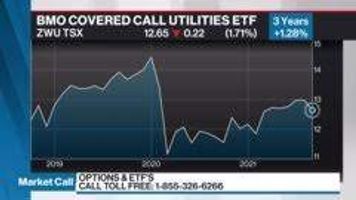
For income seekers, he's recommended this one with its covered call exposure. You get a big percentage of that return coming by way of capital gain, which is your most efficient way of paying tax. The chart shows only the price, and not the total return (which is ~7% annually, and very tax-efficient).
'%20fill='%23ffffff'%3e%3cg%20id='Pager'%20transform='translate(423.000000,%201755.000000)'%3e%3cpath%20d='M243.295367,17.286474%20C243.68919,16.9045087%20244.327703,16.9045087%20244.721525,17.286474%20L249,21.4361302%20L253.278475,17.286474%20C253.672297,16.9045087%20254.31081,16.9045087%20254.704633,17.286474%20C255.098456,17.6684393%20255.098456,18.2877274%20254.704633,18.6696927%20L249.35654,23.856763%20C249.159628,24.0477457%20248.840372,24.0477457%20248.64346,23.856763%20L243.295367,18.6696927%20C242.901544,18.2877274%20242.901544,17.6684393%20243.295367,17.286474%20Z'%20id='Path'%20transform='translate(249.000000,%2020.500000)%20rotate(-90.000000)%20translate(-249.000000,%20-20.500000)%20'%3e%3c/path%3e%3c/g%3e%3c/g%3e%3c/g%3e%3c/svg%3e)

Popular Articles





BMO Covered Call Utilities ETF (ZWU.TO) Frequently Asked Questions
What is BMO Covered Call Utilities ETF stock symbol?
BMO Covered Call Utilities ETF is a Canadian stock, trading under the symbol ZWU.TO (previously ZWU-T on Stockchase) on the Toronto Stock Exchange (ZWU-CT). It is usually referred to as TSX:ZWU or ZWU.TO
Is BMO Covered Call Utilities ETF a buy or a sell?
16 expert ratings on BMO Covered Call Utilities ETF (ZWU.TO) in the last 12 months: 15 Buy, 0 Hold, 1 Sell. Latest rating: BUY by Larry Berman CFA, CMT, CTA on Oct 5, 2026. Read the latest stock experts' ratings for BMO Covered Call Utilities ETF.
Is BMO Covered Call Utilities ETF a good investment or a top pick?
BMO Covered Call Utilities ETF was recommended as a Top Pick by Larry Berman CFA, CMT, CTA on 2026-10-05. Read the latest stock experts ratings for BMO Covered Call Utilities ETF.
Why is BMO Covered Call Utilities ETF stock dropping?
Earnings reports or recent company news can cause the stock price to drop. Read stock experts' recommendations for BMO Covered Call Utilities ETF.
Is BMO Covered Call Utilities ETF worth watching?
BMO Covered Call Utilities ETF is followed by 403 investors on Stockchase and is a trending stock that is worth watching.
What is BMO Covered Call Utilities ETF stock price?
On 2026-10-14, BMO Covered Call Utilities ETF (ZWU.TO) stock closed at a price of $11.01.
'%20fill='%23FFB800'%3e%3cg%20id='filled-.-button'%20transform='translate(120.000000,%20413.999972)'%3e%3cpath%20d='M101.499729,2.82302245e-05%20C102.285413,-0.00432461793%20103.254164,0.496634241%20103.645655,1.25173399%20L103.712109,1.39623206%20L105.747863,6.45331817%20L111.028779,6.80428588%20C111.60867,6.84282525%20112.147242,7.1236355%20112.517275,7.58038413%20C113.223405,8.45199453%20113.142035,9.72214747%20112.357105,10.4940033%20L112.234099,10.6059323%20L108.072656,14.10894%20L109.356339,19.592529%20C109.472157,20.0872738%20109.394126,20.6085551%20109.13883,21.0455786%20C108.624329,21.9263208%20107.536956,22.2447485%20106.649713,21.8010736%20L106.511398,21.7246573%20L101.5,18.7715858%20L96.4886024,21.7246573%20C95.5790916,22.2767096%2094.4027498,21.9726757%2093.8611695,21.0455786%20C93.6058745,20.6085551%2093.5278433,20.0872738%2093.6436608,19.592529%20L94.9273443,14.10894%20L90.7659013,10.6059323%20C89.8680707,9.85015912%2089.7412886,8.49557505%2090.4827254,7.58038413%20C90.8527577,7.1236355%2091.39133,6.84282525%2091.9712215,6.80428588%20L97.2521374,6.45331817%20L99.2878908,1.39623206%20C99.6240254,0.561228427%20100.665516,-0.00460395016%20101.499729,2.82302245e-05%20Z'%20id='top-picks-.-icon-copy-7'%3e%3c/path%3e%3c/g%3e%3c/g%3e%3c/g%3e%3c/svg%3e)
'%3e%3cg%20id='filled-.-button'%20transform='translate(120.000000,%20413.999944)'%3e%3cg%20id='Group-8'%20transform='translate(90.000000,%200.000000)'%3e%3cpath%20d='M11.4997292,5.58581788e-05%20C12.2854126,-0.00429698998%2013.2541635,0.496661868%2013.6456551,1.25176162%20L13.7121092,1.39625969%20L15.7478626,6.4533458%20L21.0287785,6.8043135%20C21.60867,6.84285288%2022.1472423,7.12366313%2022.5172746,7.58041175%20C23.2234049,8.45202216%2023.142035,9.7221751%2022.3571045,10.4940309%20L22.2340987,10.60596%20L18.0726557,14.1089676%20L19.3563392,19.5925566%20C19.4721567,20.0873014%2019.3941255,20.6085828%2019.1388305,21.0456062%20C18.6243292,21.9263484%2017.5369557,22.2447761%2016.6497127,21.8011012%20L16.5113976,21.7246849%20L11.5,18.7716134%20L6.48860242,21.7246849%20C5.5790916,22.2767372%204.40274983,21.9727033%203.86116953,21.0456062%20C3.60587449,20.6085828%203.52784326,20.0873014%203.64366079,19.5925566%20L4.9273443,14.1089676%20L0.76590125,10.60596%20C-0.13192926,9.85018675%20-0.258711404,8.49560268%200.482725407,7.58041175%20C0.85275775,7.12366313%201.39132997,6.84285288%201.97122149,6.8043135%20L7.25213737,6.4533458%20L9.28789079,1.39625969%20C9.62402537,0.561256055%2010.6655161,-0.00457632221%2011.4997292,5.58581788e-05%20Z'%20id='top-picks-.-icon-copy-7'%20fill='%23FFB800'%3e%3c/path%3e%3cpath%20d='M11.4997292,2.77818228e-05%20C12.2854126,-0.00429698998%2013.2541635,0.496661868%2013.6456551,1.25176162%20L13.7121092,1.39625969%20L15.7478626,6.4533458%20L21.0287785,6.8043135%20C21.60867,6.84285288%2022.1472423,7.12366313%2022.5172746,7.58041175%20C23.2234049,8.45202216%2023.142035,9.7221751%2022.3571045,10.4940309%20L22.2340987,10.60596%20L18.0726557,14.1089676%20L19.3563392,19.5925566%20C19.4721567,20.0873014%2019.3941255,20.6085828%2019.1388305,21.0456062%20C18.6243292,21.9263484%2017.5369557,22.2447761%2016.6497127,21.8011012%20L16.5113976,21.7246849%20L11.5,18.7716134%20C11.4998195,6.25722299%2011.4997292,2.77818228e-05%2011.4997292,2.77818228e-05%20Z'%20id='top-picks-.-icon-copy-8'%20fill='%23EAEAEA'%3e%3c/path%3e%3c/g%3e%3c/g%3e%3c/g%3e%3c/g%3e%3c/svg%3e)
Likes it a lot below $11, good value. Not a lot of growth, but a good place to hide with a lot of yield. Writes options further out of the money, and on only part of the portfolio. Lots of income from utilities, telcos, pipelines, etc.