Halloween Sale
50% off Premium Yearly
- Page 1/3
'%20fill='%23000000'%3e%3cg%20id='Rating-Card'%20transform='translate(120.000000,%20487.000000)'%3e%3cpath%20d='M848.295367,82.286474%20C848.68919,81.9045087%20849.327703,81.9045087%20849.721525,82.286474%20L854,86.4361302%20L858.278475,82.286474%20C858.672297,81.9045087%20859.31081,81.9045087%20859.704633,82.286474%20C860.098456,82.6684393%20860.098456,83.2877274%20859.704633,83.6696927%20L854.35654,88.856763%20C854.159628,89.0477457%20853.840372,89.0477457%20853.64346,88.856763%20L848.295367,83.6696927%20C847.901544,83.2877274%20847.901544,82.6684393%20848.295367,82.286474%20Z'%20id='Path'%3e%3c/path%3e%3c/g%3e%3c/g%3e%3c/g%3e%3c/svg%3e)
Doesn't expect any substantial agreement before meeting in Korea. Instead, he expects it to take years and years to play out. During Trump 1.0 they had a bunch of handshake agreements, yet China didn't really deliver on anything in the coming years.
Trump is mindful of that experience. But his ego demands that he gets the big handshake and can say that he got something done. Then he'll let the team work it out in the background.
Both sides will claim some sort of victory, but the important thing the market likes today is any plans to curtail rare earths minerals being deferred for at least a year. That tells us that there's at least a year before we have something material in terms of a signed deal.

One thing he likes that Mark Carney said recently was that Canada should expand trade with the rest of the world. One of the best ways we can do that is through our natural resources, including more pipeline capacity to both the East and West Coasts. If that's what the PM has in mind, then he gets a handclap from Larry. But if it's something different, good luck with that. Most of our trade does go to the US, and a huge part of that is still oil & gas.
Foreign business investment in Canada is important too. It's so hard to get stuff done here. Interprovincial trade barriers, regulations, and on and on. We really need that dynamic to change. Carney understands that, but whether he can deliver on it is the question.

Of the group, MSFT is the most interesting to him. While it's expensive at 34x forward PE, it's not terribly so. Over its history, it prices in a lot of good news the way it did toward the end of 2021. Then something negative will come up (not necessarily company-specific), and the stock corrects pretty significantly because of its valuation.
Stock ran up from the panic selloff in April, going from $350 to $550. Post-earnings, if it can't get to and hold $550, then it tells him we'll be in a sideways pattern that could last a year or so.


He's assuming the question refers to the equity, not bond, market correcting. The answer is that it depends. When a real return bond is issued, it's issued at a coupon that's the prevailing rate of interest in the marketplace plus the expected rate of inflation.
As future payments are made, what's realized by the bond is the current rate of interest plus what the inflation rate is at the time. So you're getting an adjustment to the distribution on one of these securities.
So the question becomes what's already priced into the current price regarding future rates of inflation? If the stock market's correcting because the economy is getting hit hard, then it's typically because inflation is going down not up. So your coupon payment will fall, which doesn't make ZRR a good hedge.
Where real return bonds work is when inflation's really low, future inflation is expected to increase, and you don't want to use nominal bonds (which perform badly when inflation is rising). The final answer is don't use real return bonds to hedge equity risk in your portfolio; use nominal bonds instead.
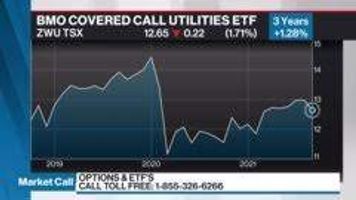
Rule of thumb: look at what an ETF owns. This one owns utilities (interest-rate sensitive), but it also owns pipelines and telcos. If the economy's weakening, then telcos and pipelines probably soften up. In that case, utilities might rally because interest rates are falling. There's no simple answer, but generally ZWU will perform better in a downturn because it's less economically sensitive to an overall market correction driven by economic weakness.
If the economy weakens, then banks are going to fall. If you had ZWB, you'd want to take $$ out of there and put it in ZWU. Doesn't mean ZWU won't go down (as it largely depends on what's driving market weakness), but it'll go down less.
For those investors who want/need the income, ZWU is the most defensive way to extract that high yield. One of his favourites.


Likes oil & gas a lot. US has rebuilding of the strategic petroleum reserve, which should create a floor under the market. Narrative in the market is that oil and gas are oversupplied.
Stock's weakening of late, and he doesn't know the specifics as well as he should. But he likes the space. Looking at the chart, stock doesn't seem to have come off all that much.

When you put these 2 together, you essentially get the TSX. These ETFs split up the TSX into growth and value in the traditional sense. You might as well just buy XIC.
Value has the banks and a lot of the energy names. If you want value in Canada, just go to the banks directly or to one of the broad-based financial services ETFs. When you look at growth, you have SHOP and CSU and some gold/silver companies -- that's the definition of growth in Canada. If you want to be a growth investor, don't look to Canada. He wouldn't use XCG in any portfolio he can think of.

When you put these 2 together, you essentially get the TSX. These ETFs split up the TSX into growth and value in the traditional sense. You might as well just buy XIC.
Value has the banks and a lot of the energy names. If you want value in Canada, just go to the banks directly or to one of the broad-based financial services ETFs. When you look at growth, you have SHOP and CSU and some gold/silver companies -- that's the definition of growth in Canada. If you want to be a growth investor, don't look to Canada. He wouldn't use XCG in any portfolio he can think of.
In a correction phase. Could pull back to somewhere near $3400-3600. That's where he'd want to put fresh money in. Violent move up and correction in the last few weeks tells him that we've likely hit some sort of speculative peak above $4000. He wouldn't be interested in any gold companies, whether junior or senior, until we get more of a correction.
How sustainable and long-term is this play in gold? It could be years. But we've also seen historically where you get these speculative things, they ramp up, and then it's dead money for a decade. That's a real risk to think about for this sector. It's not a no-brainer.
He missed this last runup, thinking it wasn't sustainable. (So don't listen to him, he was wrong on that ;) But he is bullish long term, and would buy this type of correction. There are a number of ETFs to play this, and they're all basically the same.


Good question. The asset management piece is narrower than the entire Brookfield. It's a great, well-run company, so either one is fine. Overall, parent company might be a bit better longer term. But from time to time the asset management business will shine because of specific things going on in its universe.
As to which is better, it's a coin flip at any point in time.

Good question. The asset management piece is narrower than the entire Brookfield. It's a great, well-run company, so either one is fine. Overall, parent company might be a bit better longer term. But from time to time the asset management business will shine because of specific things going on in its universe.
As to which is better, it's a coin flip at any point in time.
%20-%20http://www.bohemiancoding.com/sketch%20--%3e%3ctitle%3ePath%205%3c/title%3e%3cdesc%3eCreated%20with%20Sketch.%3c/desc%3e%3cg%20id='Page-1'%20stroke='none'%20stroke-width='1'%20fill='none'%20fill-rule='evenodd'%20stroke-linecap='round'%20stroke-linejoin='round'%3e%3cg%20id='mobile'%20transform='translate(-353.000000,%20-32.000000)'%20stroke='%2325292B'%20stroke-width='1.5'%3e%3cg%20id='Group'%20transform='translate(321.000000,%2022.000000)'%3e%3cpath%20d='M33,11%20L36.2928932,14.2928932%20C36.6834175,14.6834175%2037.3165825,14.6834175%2037.7071068,14.2928932%20L41,11'%20id='Path-5'%3e%3c/path%3e%3c/g%3e%3c/g%3e%3c/g%3e%3c/svg%3e)

Popular Articles
Most Recent Experts




Most popular stocks on Stockchase
- Toronto-Dominion Bank (TD.TO)
- Enbridge (ENB.TO)
- BCE Inc. (BCE.TO)
- Manulife Financial (MFC.TO)
- Bank of Nova Scotia (BNS.TO)
- Apple Inc (AAPL)
- Suncor Energy Inc (SU.TO)
- Microsoft Corp (MSFT)
- Canadian Natural Rsrcs (CNQ.TO)
- Royal Bank (RY.TO)
- Telus Corp (T.TO)
- TC Energy (TRP.TO)
- Alphabet Inc (GOOG)
- Canadian National R.R. (CNR.TO)
- Crescent Point Energy Corp (CPG.TO)
- Amazon.com, Inc. (AMZN)
- Teck Resources Ltd. (B) (TECK.B.TO)
- BlackBerry (BB.TO)
- Fortis Inc. (FTS.TO)
- NVIDIA Corporation (NVDA)
- Canadian Imperial Bank of Commerce (CM.TO)
- Bank of Montreal (BMO.TO)
- Bank of America (BAC)
- Bombardier Inc (B) (BBD.B.TO)
- Algonquin Power & Utilities Corp (AQN.TO)
- Pembina Pipeline Corp (PPL.TO)
- Meta Platforms Inc (META)
- Walt Disney Co. (DIS)
- Sun Life Financial Inc (SLF.TO)
- Arc Resources Ltd (ARX.TO)