Halloween Sale
50% off Premium Yearly
A Comment -- General Comments From an Expert (A Commentary)

Because of big market gains this is not a time to chase growth stocks. Look for opportunities in areas the market is ignoring for various reasons. There are opportunities in the commodity and emerging equity markets especially in Asia. Inflation is slowing and the market is expecting a Chinese stimulus which may or may not happen. China and India have mopped up the Russian demand for oil. The U.S. may have a recession but it is too early to tell.

The question was on the cyber security space. He is very positive on the sector since consumers, corporations and governments need it. He favours more mature companies with profits over new performers but it is a good strategy to start looking for opportunities. If there is a recession tech will go down which will make a good opportunity to buy.
The rally continues because earnings continue to deliver. Consensus expects the topline to see some slowing, but better margins will make up for that. Can we continue to deliver that topline into 2024? Her concern is that the rest of the world (ex-USA) is rapidly contracting. The market expected China's reopening to drive demand for cyclicals like energy and materials, but have lagged this year--Chinese demand wasn't there.


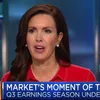
It's been a bull market this year, but he fears a pullback in August-October. It's won't derail the overall rally; we can finish the year at record highs. Given yesterday's GDP data, we're not talking soft landing anymore, but maybe no landing. The Fed could hike once or twice more and that could throw off the market. He has been trimming big tech like Apple, Microsoft and Amazon because of overweighting in his portfolio. He hit a home run with tech this year, so he wants to be ready (to buy dips) in the second half of this year. He's seeking outperformance in healthcare, niche industrials and small caps. He remains bullish tech. He hols 8-9% cash. He can go shopping if there's a pullback.

Believes inflation numbers moving in the right direction in Canada & USA.
Central interest rate policy very influential the past 24 months in financial markets.
Corporate earnings are trending nicely the past few weeks.
Tension between inflation & interest rate policy will have major impact the next 9-12 months.
Summer seasonality (less trading volumes) will create volatility in the markets.
Best opportunities for investors exist in small cap stocks - not widely covered.

Strength of Canadian Economy:
The Canadian economy grew at an annualized rate of 3.1% in the first quarter of 2023, as per Statistics Canada, while the US reported the number to be at 2.0%. US GDP is on track to have increased by 2.3% in the second quarter of 2023, while S&P Global calls for a dip of 0.6% in the Canadian economic activity in the second quarter. For the year, however, S&P Global expects the real GDP to grow by 0.8% for Canada.
The remarkable unemployment rates in both countries are playing a key role in elevating consumer confidence and fostering a positive economic outlook. Growth is only expected to decelerate slightly due to slower growth in disposable income. This can be due to high mortgage costs in Canada or student debt payments in the US.
The strength and resilience shown by the economies, the ongoing strength in the job market, and the continued growth in GDP suggest that the Canadian and US economies will continue to grow, albeit at a slower pace. The odds of a recession are sliding.
Unlock Premium - Try 5i Free

;fill-opacity:1;'/%3e%3cpath%20d='M31%2018.6001V30H8V18.6001L14.1334%2022.4334L19.4999%2014L24.8669%2022.4334L31%2018.6001Z'%20fill='%23EE5432'%20style='fill:%23EE5432;fill:color(display-p3%200.9340%200.3310%200.1956);fill-opacity:1;'/%3e%3c/svg%3e) Premium content
Premium content- DTE Energy Company (DTE-N)
- A.O. Smith (AOS-N)
- Tupperware Brands (TUP-N)
- Meta Platforms Inc / Facebook (META-Q)
- Apple Inc (AAPL-Q)
- Texas Instruments (TXN-Q)
- GameStop Corp. (GME-N)
- Main Street Capital Corp. (MAIN-N)
- Invesco QQQ Trust, Series 1 (QQQ-Q)
- CME Group Inc (CME-Q)
- NVIDIA Corporation (NVDA-Q)
- Kellog (K-N)
- Digital World Acquisition Corp. (DWAC-Q)
- Loews Corp (L-N)
- AT&T (T-N)

It's been 9 months since the lows of October 2022. One word describes the rally, it's all about resilience. Many challenges such as a banking crisis in the spring, rising rates along the way, lingering recession worries. Markets are all 30% or higher at this point from the October lows.
Earlier this year, there were concerns about market breadth. Recently, we're seeing breadth expand. About 75% of the S&P 500 constituents are trading above their 200-day moving averages. Broader participation in the rally from other sectors, which is very healthy.

He attributes expanding breadth of the S&P rally to inflationary pressures cooling, which will lead to a pause in central banks' interest rate hiking. Potentially in 2024, we'll see a lowering of interest rates. Futures in the back half of the year show we may see some falling interest rates in the US. A stable interest rate environment is always good for stocks and bonds.
He owns MSFT, but getting a bit pricey based on valuation. Also AMZN and AAPL, neither is too pricey. GOOG is a name to look at. AMZN is rebounding and in a clear uptrend. On his radar is FTNT.
He's very careful of the tech market. We had a pretty decent run until a month ago, but now rotation out of tech. If you look at the S&P Tech sector, it's trading around 7.1x price to sales. 10-year average is 4.5x. Years 1999-2000, it was around 7.5x or so, and then the S&P Tech index dropped 83%. Not that that's going to happen, but we need to be aware of valuations in the tech space in general.
See his Top Picks.
'%20fill='%23ffffff'%3e%3cg%20id='Pager'%20transform='translate(423.000000,%201755.000000)'%3e%3cpath%20d='M243.295367,17.286474%20C243.68919,16.9045087%20244.327703,16.9045087%20244.721525,17.286474%20L249,21.4361302%20L253.278475,17.286474%20C253.672297,16.9045087%20254.31081,16.9045087%20254.704633,17.286474%20C255.098456,17.6684393%20255.098456,18.2877274%20254.704633,18.6696927%20L249.35654,23.856763%20C249.159628,24.0477457%20248.840372,24.0477457%20248.64346,23.856763%20L243.295367,18.6696927%20C242.901544,18.2877274%20242.901544,17.6684393%20243.295367,17.286474%20Z'%20id='Path'%20transform='translate(249.000000,%2020.500000)%20scale(-1,%201)%20rotate(-90.000000)%20translate(-249.000000,%20-20.500000)%20'%3e%3c/path%3e%3c/g%3e%3c/g%3e%3c/g%3e%3c/svg%3e)
'%20fill='%23ffffff'%3e%3cg%20id='Pager'%20transform='translate(423.000000,%201755.000000)'%3e%3cpath%20d='M243.295367,17.286474%20C243.68919,16.9045087%20244.327703,16.9045087%20244.721525,17.286474%20L249,21.4361302%20L253.278475,17.286474%20C253.672297,16.9045087%20254.31081,16.9045087%20254.704633,17.286474%20C255.098456,17.6684393%20255.098456,18.2877274%20254.704633,18.6696927%20L249.35654,23.856763%20C249.159628,24.0477457%20248.840372,24.0477457%20248.64346,23.856763%20L243.295367,18.6696927%20C242.901544,18.2877274%20242.901544,17.6684393%20243.295367,17.286474%20Z'%20id='Path'%20transform='translate(249.000000,%2020.500000)%20rotate(-90.000000)%20translate(-249.000000,%20-20.500000)%20'%3e%3c/path%3e%3c/g%3e%3c/g%3e%3c/g%3e%3c/svg%3e)