Halloween Sale
50% off Premium Yearly
TSE:ZWU
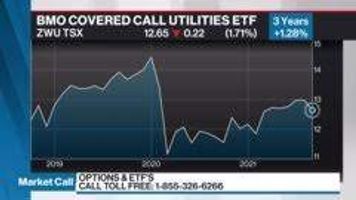
BMO Covered Call Utilities ETF (ZWU.TO)
 Financials
  Technical Analysis
Rule of thumb: look at what an ETF owns. This one owns utilities (interest-rate sensitive), but it also owns pipelines and telcos. If the economy's weakening, then telcos and pipelines probably soften up. In that case, utilities might rally because interest rates are falling. There's no simple answer, but generally ZWU will perform better in a downturn because it's less economically sensitive to an overall market correction driven by economic weakness.
If the economy weakens, then banks are going to fall. If you had ZWB, you'd want to take $$ out of there and put it in ZWU. Doesn't mean ZWU won't go down (as it largely depends on what's driving market weakness), but it'll go down less.
For those investors who want/need the income, ZWU is the most defensive way to extract that high yield. One of his favourites.
Going all in on any one sector is a bit extreme. If we get into higher-than-expected inflation, utilities will struggle. Defensive tilt, and sells calls to enhance income. Low volatility sector means call-writing premium also lower. Fine choice for part of a diversified portfolio.

Depends on your asset allocation, risk tolerance, and whether the GIC is in a registered account or not. He likes the BMO lineup for ETFs a lot. With lower interest rates and the thirst for data centres, thinks there's more to go in the utility space.
He himself writes covered calls on stocks. So he doesn't like ETFs that, as a mandate, have to write covered calls. It looks enticing, but the miracle of stocks is the growth you get from not selling calls or only selling them selectively as a tool.

He always advocates diversifying a portfolio. You don't want to have too much in one name. Ever. He doesn't know the percentage of the investor's portfolio. If BCE is only 1% of the portfolio and with BCE being relatively cheap, he'd stick with it. But if BCE is a huge part of the portfolio, then diversifying that risk away would make sense.
Here's the challenge: what's in XDV? Banks, lifecos, energy names. Has done well in recent years, whereas BCE has underperformed dramatically.
For more diversification, he'd look at ZWU -- gives you some telcos and utilities plus a covered call. Still some exposure to BCE, but diversified within the utilities space and given you an enhanced yield. Nice, tax-efficient yield north of 7%. And you don't have the current extremes of the banks and lifecos of XDV.

He used to manage this. Even during the April meltdown, this didn't fall as far as the market. There is still risk here, but the extra income through covered calls helps. Is defensive without huge returns, but you need some defence in a portfolio. If the market falls 30%, ZWU would fall 15%.

This is an accounting item. There are 2 types of ROC, 1 good and 1 bad. The bad one is where the ETF provider is goosing up the return to be seen to be giving you more of a yield, but they end of giving you some of your own money back. That's not good. BMO doesn't do that.
To find out which one it is, you can call the ETF provider. Here's another way. Look at the underlying holdings. For example, assume they pay a dividend of 4%, there's an MER for the fund, and the option overlay generates a return of 2-3% a year. If you're being paid 6-7%, it's all good and you're getting it all. But if you're being paid 6%, but none of the underlying holdings pay 6% and there's no covered call overlay, then you're getting some of your own money back
ZWU holds Canadian utilities, writes covered calls on ~50% of the portfolio. Use it if you have a neutral or range-bound view of the Canadian utilities market. If you buy near market bottom, won't participate as much in the snap-back.
If you see growth and capital appreciation on the horizon, use ZUT -- almost the same basket, but with no covered call overlay. Lower yield. Money works for you over the long haul.

'%20fill='%23ffffff'%3e%3cg%20id='Pager'%20transform='translate(423.000000,%201755.000000)'%3e%3cpath%20d='M243.295367,17.286474%20C243.68919,16.9045087%20244.327703,16.9045087%20244.721525,17.286474%20L249,21.4361302%20L253.278475,17.286474%20C253.672297,16.9045087%20254.31081,16.9045087%20254.704633,17.286474%20C255.098456,17.6684393%20255.098456,18.2877274%20254.704633,18.6696927%20L249.35654,23.856763%20C249.159628,24.0477457%20248.840372,24.0477457%20248.64346,23.856763%20L243.295367,18.6696927%20C242.901544,18.2877274%20242.901544,17.6684393%20243.295367,17.286474%20Z'%20id='Path'%20transform='translate(249.000000,%2020.500000)%20scale(-1,%201)%20rotate(-90.000000)%20translate(-249.000000,%20-20.500000)%20'%3e%3c/path%3e%3c/g%3e%3c/g%3e%3c/g%3e%3c/svg%3e)
'%20fill='%23ffffff'%3e%3cg%20id='Pager'%20transform='translate(423.000000,%201755.000000)'%3e%3cpath%20d='M243.295367,17.286474%20C243.68919,16.9045087%20244.327703,16.9045087%20244.721525,17.286474%20L249,21.4361302%20L253.278475,17.286474%20C253.672297,16.9045087%20254.31081,16.9045087%20254.704633,17.286474%20C255.098456,17.6684393%20255.098456,18.2877274%20254.704633,18.6696927%20L249.35654,23.856763%20C249.159628,24.0477457%20248.840372,24.0477457%20248.64346,23.856763%20L243.295367,18.6696927%20C242.901544,18.2877274%20242.901544,17.6684393%20243.295367,17.286474%20Z'%20id='Path'%20transform='translate(249.000000,%2020.500000)%20rotate(-90.000000)%20translate(-249.000000,%20-20.500000)%20'%3e%3c/path%3e%3c/g%3e%3c/g%3e%3c/g%3e%3c/svg%3e)





Utilities, mostly in Canada -- 30% US, 70% Canada. Pipelines and telcos. A lot less market sensitive. More defensive in theory; unless oil prices collapse, pipelines go down, and telcos go down further. If interest rates shoot up, utilities go down. He doesn't think any of those things are going to happen. So he'd pick this one as a more defensive way to make the shift to defense.
ZPAY is all US exposure. Uses optionality to generate significant income. There's a lot less risk to the overall market. However, it's all equity risk and it's US large-cap stocks. So if you're taking profits on riskier, growth-oriented investments, you're getting back into the same thing albeit with a better yield and risk/reward profile.
You don't need both. Pick one or the other.